
Why does one word have the power to change how we think, buy, and behave?
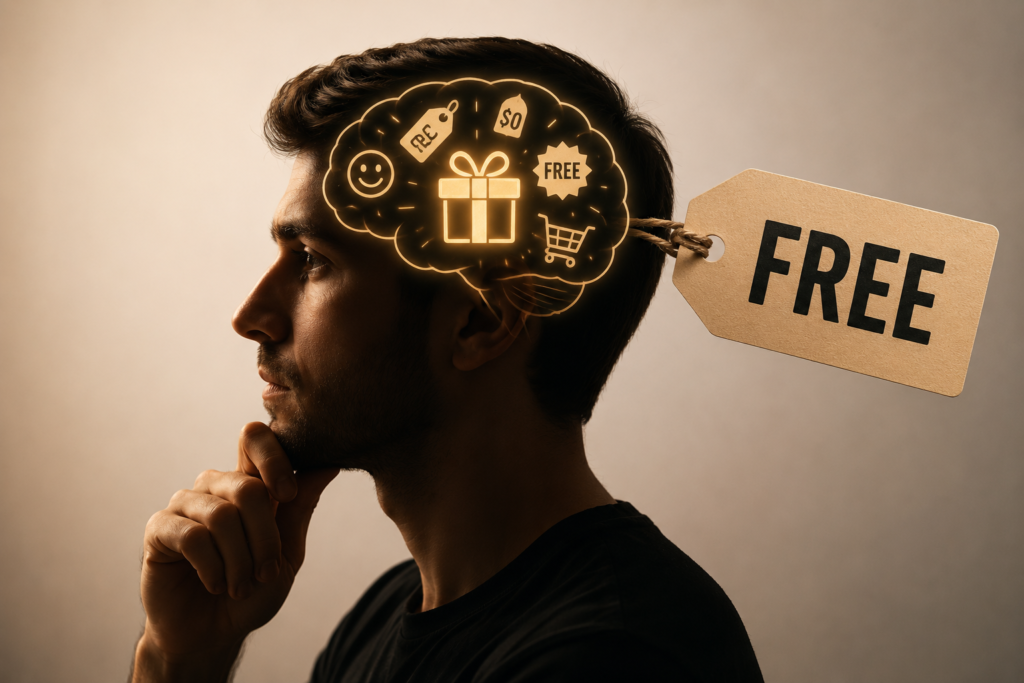
What happens when a product that costs ₹100 suddenly becomes FREE?
We know that free doesn’t always mean better.
We know that a “free” offer can sometimes encourage us to spend more.
And yet, the moment we see the word FREE, our decision-making can change.
This isn’t simply a pricing strategy.
It’s psychology.
1. Why Does “Free” Feel So Different?
Imagine two offers:
Offer A:
Buy a chocolate for ₹10.
Offer B:
Get a chocolate for FREE.
The difference is only ₹10.
But psychologically, the difference feels much larger.
Why?
Because zero is not simply another price point.
When something costs ₹1, we still evaluate whether it is worth ₹1.
When something costs ₹0, we often stop evaluating the price in the same way.
The perceived risk disappears.
There is nothing to lose financially.
And that makes the decision feel almost effortless.
This is one reason marketers have used “free” for everything from samples and trials to shipping, subscriptions and promotional offers.
2. The “Zero-Price Effect”
One of the most interesting concepts in consumer psychology is the zero-price effect.
Research by Dan Ariely and Kristina Shampanier examined how consumers respond to free products and found that reducing a price from a small positive amount to zero can produce a disproportionately large increase in demand.
In one experiment, consumers chose between a Hershey’s Kiss and a Lindt truffle.
When both prices were reduced by the same amount, the preference didn’t simply move proportionally.
When the Kiss became free, consumers became much more attracted to the free option.
The important insight was:
Free can change the way consumers perceive value, rather than simply reducing the price.
That is what makes “free” so powerful.
3. Free Removes the Fear of Making the Wrong Decision
Every purchase contains some degree of uncertainty.
You might think:
- What if I don’t like it?
- What if it’s not worth the money?
- What if I find something better?
- What if I waste my money?
A free product removes much of the financial risk.
If you pay ₹1,000 and dislike something, you’ve lost ₹1,000.
If you try something for free and dislike it, you haven’t lost money.
That makes trial much easier.
This is why businesses frequently use:
- Free trials
- Free samples
- Free consultations
- Free demos
- Free downloads
- Free accounts
The objective isn’t necessarily to make money from the free product.
The objective can be to reduce the psychological barrier to the first interaction.
4. Free Can Create an Emotional Reaction
Pricing is often treated as mathematics.
But consumers don’t always experience prices mathematically.
Seeing:
₹999 → ₹499
creates one reaction.
Seeing:
₹999 → FREE
creates a completely different emotional response.
The word “free” can trigger:
- Excitement
- Curiosity
- Urgency
- Perceived opportunity
- Fear of missing out
This is why “free” is often more powerful in advertising than simply communicating a discount.
5. Free Doesn’t Always Mean “No Cost”
Here’s where things become particularly interesting.
A product can be financially free while still having other costs.
For example:
Free app
You may not pay money.
But you may provide:
- Personal data
- Attention
- Advertising exposure
- Usage information
Free delivery
The delivery may be free, but the cost may already be incorporated into the product price.
Free trial
The trial may eventually convert into a paid subscription.
Buy One Get One Free
The “free” product may encourage you to purchase something you weren’t originally planning to buy.
So marketers need to distinguish between:
Free to the customer
and
Costless to the business.
They are not the same thing.
6. Why “Free Shipping” Works So Well
Consider two online stores.
Store A
Product: ₹800
Shipping: ₹100
Total: ₹900
Store B
Product: ₹900
Shipping: FREE
The total cost is identical.
But many consumers perceive Store B differently.
Why?
Because shipping feels like an additional penalty.
The customer already wants the product.
Adding another charge at checkout can feel like an unexpected cost.
Calling shipping “free” removes that psychological pain.
This is a good example of how the way a price is presented can influence perception, even when the final amount isn’t dramatically different.
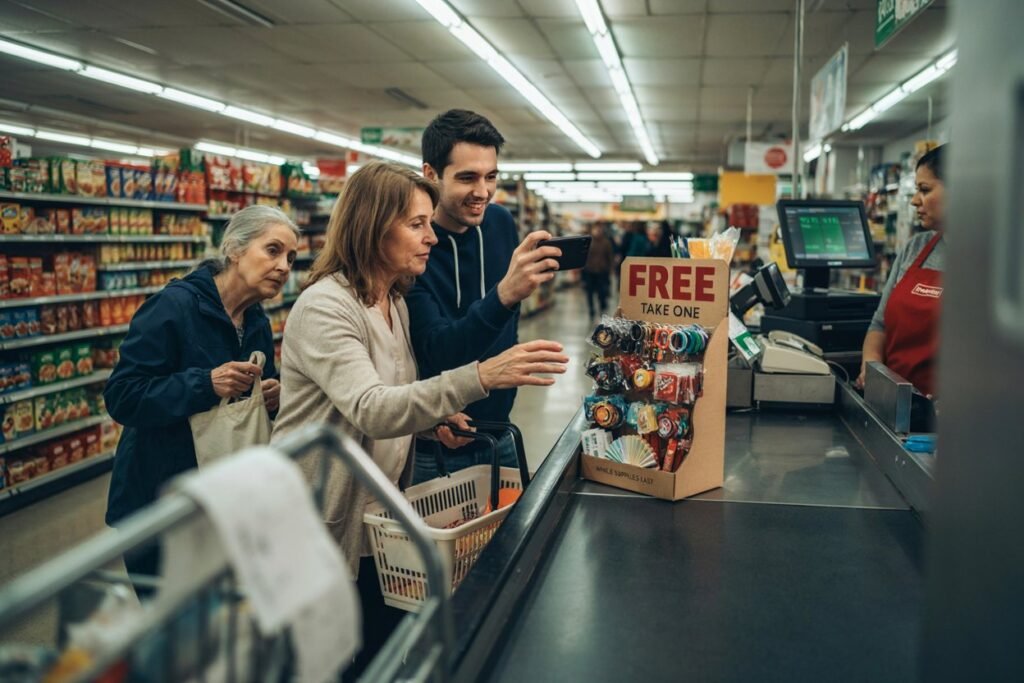
7. The Power of Free Samples
Walk into a supermarket and you might see someone offering a small sample.
You weren’t planning to buy the product.
But you try it.
Now something has changed.
You have experienced the product rather than simply seeing it.
The business has moved you from:
Awareness → Trial
And trial can make the next decision easier.
This is particularly useful for products where customers are uncertain about quality.
Food, cosmetics, software, services and many other categories can benefit from reducing the risk of the first experience.
8. Free as a Customer Acquisition Strategy
From a business perspective, free can be used as a customer acquisition tool.
Think about the journey:
Free interaction
↓
Customer tries the product
↓
Customer experiences value
↓
Customer develops trust
↓
Customer considers paid product
The free offer becomes an entry point into the relationship.
This is particularly common in digital businesses.
A company might offer:
- Free basic plan
- Free trial
- Free educational content
- Free tool
- Free consultation
The goal is to demonstrate value before asking for payment.
9. The Freemium Model
One of the most recognizable examples is freemium.
The business offers a basic version for free while charging for premium features.
The psychology is simple:
Let customers experience enough value that they eventually want more.
For example:
Free
→ Basic features
Premium
→ Advanced features
The free version reduces the barrier to adoption.
The premium version monetizes customers who see enough value to pay.
But freemium only works when the free product provides real value.
If the free version is useless, customers have no reason to become paid customers.
10. Free Can Create Reciprocity
There is another psychological principle marketers should understand:
Reciprocity.
When someone gives us something, we can feel a natural tendency to respond positively.
For example:
A company gives you a useful free guide.
You find it genuinely helpful.
Later, when you need that service, that company may already be familiar and trusted.
The free resource didn’t necessarily create an immediate sale.
It created goodwill and familiarity.
This is one reason content marketing can be so powerful.
A business that consistently provides useful information can build relationships before asking customers to buy.
11. But “Free” Can Also Create Suspicion
Free isn’t always positive.
If something appears too good to be true, consumers may become suspicious.
Imagine seeing:
“FREE iPhone!”
Your first reaction might not be excitement.
It might be:
“What’s the catch?”
This tells us something important:
The power of “free” depends on trust.
If the brand is credible, free can reduce friction.
If the brand isn’t credible, free can increase suspicion.
Therefore:
Free + Trust = Opportunity
while:
Free + Low Trust = Suspicion
12. The Dark Side of “Free”
Marketers can use free responsibly—or manipulatively.
For example:
Hidden subscriptions
A free trial automatically becomes paid without the customer realizing it.
Artificial urgency
“FREE — TODAY ONLY!”
when the same offer repeatedly appears.
Unnecessary purchases
A “free” gift encourages consumers to spend money they weren’t planning to spend.
Data exchange
A product may be free financially but collect significant amounts of user data.
These tactics may generate short-term conversions.
But they can damage customer trust.
And once trust is lost, the cost can be much greater than the original sale.
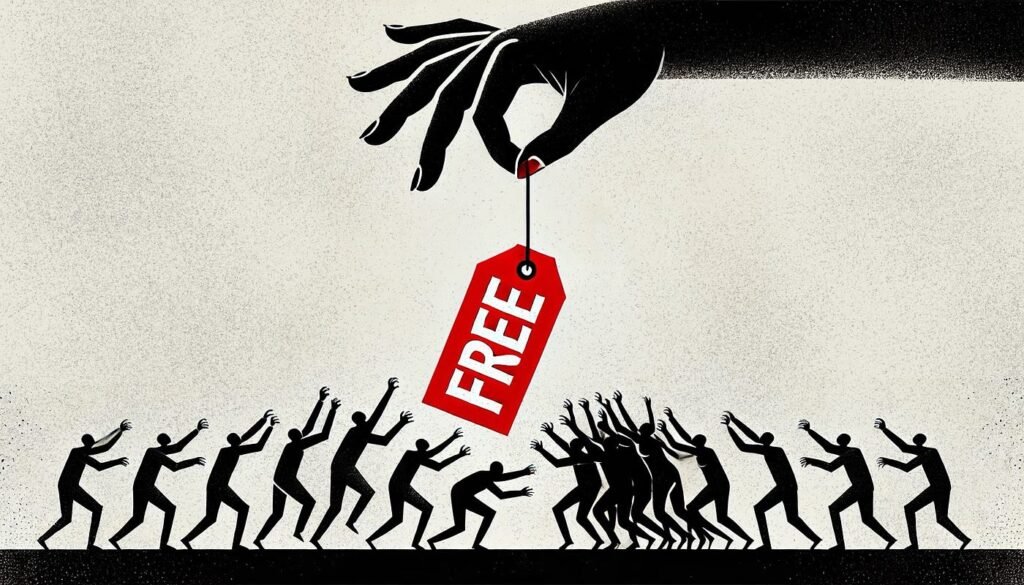
13. Free vs Discount: Which Is More Powerful?
Consider:
50% OFF
versus
FREE
They aren’t psychologically equivalent.
A discount asks:
“Is this product worth the reduced price?”
Free asks:
“Why wouldn’t I take it?”
That’s a much easier question.
But businesses need to remember:
Free attracts attention.
It doesn’t automatically create loyalty.
The product still needs to deliver value.
14. The Real Marketing Lesson
The psychology of free isn’t really about giving things away.
It’s about reducing friction.
A customer may hesitate because of:
- Price
- Risk
- Uncertainty
- Lack of trust
- Lack of information
A well-designed free offer can reduce one or more of those barriers.
But the ultimate objective shouldn’t be:
“How can we give something away?”
It should be:
“How can we make it easier for customers to experience our value?”
That’s a much stronger marketing question.
15. When Should Businesses Use “Free”?
“Free” can be particularly useful when:
The product needs to be experienced
Samples and trials can reduce uncertainty.
The customer acquisition barrier is high
Free access can encourage people to try the product.
The business has a strong upsell opportunity
A free basic product can introduce customers to premium features.
The product becomes more valuable with usage
Freemium models can work well when customers discover additional value over time.
Trust is a major barrier
Giving customers something useful before asking them to buy can help establish credibility.
16. When Should Businesses Avoid Free?
Free isn’t always the right strategy.
It can be dangerous when:
- The free offer attracts people who will never become customers.
- The cost of providing the free product is too high.
- Customers begin to expect everything for free.
- The brand becomes associated with low value.
- The business depends on constant promotions.
- The free product doesn’t lead to a clear next step.
A business shouldn’t ask:
“Can we offer something for free?”
It should ask:
“What role does free play in our customer journey?”
17. What Marketers Can Learn From the Psychology of Free
1. Zero isn’t just another number.
Moving from ₹1 to ₹0 can have a much larger psychological impact than the numerical difference suggests.
2. Reduce risk before asking for commitment.
Free trials and samples can make the first interaction easier.
3. Value comes before conversion.
If the customer experiences genuine value, the path to a paid relationship becomes stronger.
4. Presentation matters.
How you frame an offer can influence how customers perceive it.
5. Trust is essential.
Free works best when customers understand and trust the offer.
6. Don’t confuse attention with loyalty.
“Free” can get someone through the door.
Only value can keep them there.
18. The Bigger Question
The word “free” is powerful because it changes more than the price.
It can change how we perceive:
- Risk
- Value
- Opportunity
- Loss
- Convenience
- Trust
And that’s why marketers continue to use it.
But perhaps the most important lesson isn’t:
“Free sells.”
It’s:
“Reducing the perceived risk of trying something can make customers much more willing to take the first step.”
The best marketers don’t simply use psychological triggers.
They understand why those triggers work and use them to create genuine value.
Conclusion
“Free” is one of the most powerful words in marketing.
It can attract attention, reduce perceived risk, encourage trial and open the door to a long-term customer relationship.
But free by itself isn’t a strategy.
A successful business needs to answer three questions:
What are we giving away?
Why are we giving it away?
What value will the customer experience after receiving it?
Because ultimately:
Free can get the customer to try you.
Value is what gives them a reason to stay.
And that’s where the real psychology of “free” begins.
About the Author
Raheel Valappil is a marketing professional passionate about understanding how businesses grow, how customers make decisions, and how brands turn problems into opportunities.
Through his marketing research and case studies, he explores consumer behaviour, brand strategy, digital marketing, customer experience and business growth.
Follow Raheel for more marketing case studies, research, trends and practical insights.