
How redBus Turned a Broken Customer Experience into a Business Opportunity
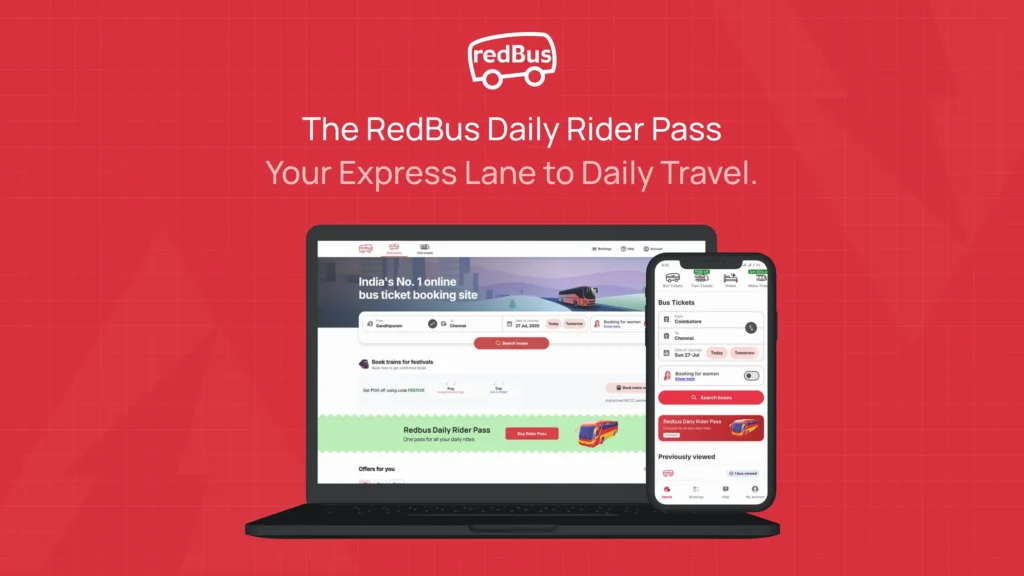
From a frustrating Diwali ticket search to a platform that transformed bus-ticket booking in India
1. Introduction: Sometimes the Best Business Ideas Start With a Bad Experience
What if one of your most frustrating customer experiences became the foundation of a business?
In 2005, Phanindra Sama wanted to travel from Bangalore to Hyderabad to spend Diwali with his family. But finding a bus ticket wasn’t simple. He had to approach multiple travel agents, only to discover that tickets were unavailable. That frustration led him to ask a simple question:
Why couldn’t bus tickets be booked online in the same way as airline and railway tickets?
That question eventually became redBus.
But the interesting part of the story isn’t simply that someone created an online ticket-booking platform.
The interesting part is how redBus identified a customer experience problem inside a fragmented market and turned that problem into a business opportunity.
2. The Customer Experience Before redBus
Before online bus ticketing became common, booking an intercity bus could involve considerable uncertainty.
Customers often depended on:
Travel agents
Individual bus operators
Phone calls
Physical ticket counters
Limited information about availability
Manually checking different options
The market was fragmented, making it difficult for customers to easily compare availability and make informed booking decisions.
The SAGE case study describes the bus reservation segment as fragmented and highlights the customer dilemma that Phanindra Sama experienced firsthand.
The fundamental problem wasn’t simply:
“There aren’t enough bus tickets.”
It was:
“Customers don’t have a simple way to discover, compare and book available tickets.”
That distinction matters.
Because good marketing often begins by identifying the real problem behind the visible problem.
3. The Moment That Created the Opportunity
Phanindra’s failed attempt to get home for Diwali became the trigger.
Instead of accepting the inconvenience, he questioned the system.
Why couldn’t there be a centralized platform?
Why couldn’t customers see available seats?
Why couldn’t bus operators manage their inventory more efficiently?
Why couldn’t customers book without visiting multiple agents?
A personal frustration became a market insight.
This is one of the most important entrepreneurial lessons from the redBus story:
A problem experienced by one customer can sometimes reveal a problem experienced by thousands.
4. From Idea to Experiment
Phanindra Sama joined forces with his friends Charan Padmaraju and Sudhakar Pasupunuri.
Their initial approach wasn’t immediately the redBus model we know today.
They developed software called BOSS, designed to help bus operators manage operations and provide visibility into seat availability. However, getting operators interested proved difficult.
This is an important part of the story because it shows that the first idea isn’t always the final business model.
The founders received mentorship through TiE Bangalore, which helped them rethink their approach.
One key recommendation was to attract customers first and then bring bus operators onto the platform. In August 2006, redBus launched as a portal selling bus tickets.
5. The Real Value Proposition
redBus wasn’t simply selling bus tickets.
It was selling something more valuable:
Convenience and certainty.
The original case study notes that the founders saw their value proposition as delivering a superior customer experience and making the bus-ticket buying process smoother and less troublesome.
Think about what changed for the customer.
Before:
Search → Call/Visit agents → Check availability → Compare options → Book
With redBus:
Search → Compare → Select → Book
The product wasn’t just technology.
The product was a better customer journey.
6. The Two-Sided Marketplace Problem
There was another major challenge.
redBus needed:
Customers + Bus operators
But customers wouldn’t necessarily use the platform without enough buses.
And bus operators wouldn’t necessarily join without customers.
This created a classic marketplace problem.
The founders had to gradually build both sides of the ecosystem.
Initially, they secured limited inventory from operators and focused on generating customer demand. As bookings increased, the platform became more attractive to operators.
This created a growth loop:
More operators → More choice → More customers → More bookings → More attractive platform for operators
That is much more powerful than simply running advertisements.
7. Marketing Before Big Marketing Budgets
One of the fascinating aspects of the early redBus story is that the company didn’t begin with a massive marketing machine.
According to Phanindra Sama’s account, the founders distributed pamphlets and even used an ex-classmate’s company discussion board to spread awareness.
One of their first customers booked tickets for a family trip from Bangalore to Tirupati.
This illustrates an important principle:
Early-stage marketing isn’t always about spending more. It’s about finding the most efficient way to reach the right customer.
The founders were effectively testing:
Can we create awareness? → Can we generate bookings? → Can we prove demand?
8. Trust Became Part of the Product
Creating an online booking platform wasn’t enough.
Customers needed to trust that the ticket they purchased would actually work.
And redBus faced serious operational challenges.
In the early stages, some operators reportedly sold tickets allocated to redBus to other customers for commissions. This created a potentially disastrous customer experience. The founders even had to send stranded customers by flight in some cases, absorbing the cost.
This highlights something marketers sometimes overlook:
Customer experience doesn’t end at the point of purchase.
The customer doesn’t care which department caused the problem.
They care about:
“Did the company deliver what it promised?”
That meant redBus had to solve the operational side of the experience—not just the digital interface.
9. Turning Customer Experience Into a Competitive Advantage
This became one of redBus’s strongest strategic ideas.
The platform wasn’t just trying to become another ticket seller.
It aimed to make the entire process:
- Easier
- More transparent
- More convenient
- More reliable
The company’s current positioning continues to emphasize convenience, choice, customer service and value.
This demonstrates an important marketing principle:
Customer experience can become part of your brand positioning.
If competitors sell the same basic product, the experience surrounding that product can become the differentiator.
10. Scaling the Customer Experience
Growth creates another problem.
What happens when you go from thousands of customers to millions?
The same manual processes that worked early on may no longer work.
redBus has continued investing in customer-experience technology.
During the COVID crisis, for example, redBus reported using technology to handle increased cancellation and support volumes. Salesforce reported that its abandoned-call rate fell from 46% to 2.5%, incorrect refunds dropped by 60%, and CSAT increased by 1.8%.
Later, redBus implemented Salesforce Service Cloud to integrate voice, email and chat and improve customer-service operations across markets. Salesforce reports a 70% improvement in case-resolution time.
The lesson:
Customer experience isn’t something you build once.
It has to evolve as the business scales.
11. From Personalization to Customer Intelligence
Modern marketing isn’t just about knowing what customers purchased.
It’s about understanding:
- What they want
- How they behave
- When they engage
- Which channels they prefer
- What communication is relevant to them
In 2023, redBus announced a collaboration with MoEngage to improve customer engagement using AI-powered insights, segmentation and personalized customer journeys.
This represents the evolution of the original idea.
The initial problem was:
“How can I book a bus ticket easily?”
The modern question becomes:
“How can we make the entire customer journey more relevant and seamless?”
12. What Actually Made redBus Successful?
It’s tempting to say:
“redBus succeeded because it moved bus booking online.”
But that’s incomplete.
Its success can be better understood through several interconnected factors:
1. It identified a genuine customer problem.
The idea came from a real customer frustration.
2. It simplified a complicated process.
It reduced friction in ticket discovery and booking.
3. It created value for multiple stakeholders.
Customers gained convenience and choice.
Operators gained another distribution channel.
Agents gained access to inventory.
The original case study specifically describes the founders’ intention to create a win-win relationship across stakeholders.
4. It built trust.
A booking platform is only valuable if customers trust the transaction.
5. It continuously improved customer experience.
Technology became a tool for improving service rather than simply a feature.
6. It developed network effects.
More operators created more choice.
More choice attracted more customers.
More customers attracted more operators.
13. The Marketing Framework Behind redBus
We can simplify the journey into five stages:
Problem
Customers struggled with bus-ticket discovery and booking.
↓
Insight
The fragmented booking process created unnecessary friction.
↓
Solution
Create a centralized digital platform.
↓
Value
Convenience, choice and a smoother customer journey.
↓
Growth
More customers + more operators + more inventory + stronger platform.
This is why I find the redBus story interesting from a marketing perspective.
It wasn’t simply:
“Let’s build an app.”
It was:
“Let’s remove friction from a customer journey.”
14. What Marketers Can Learn From redBus
Lesson 1: Start with the problem, not the product.
Don’t begin with:
“What can we sell?”
Start with:
“What problem are people struggling with?”
Lesson 2: Personal frustration can reveal market opportunity.
The founder’s personal experience wasn’t automatically a business opportunity.
The opportunity appeared when he recognized that his problem could represent a broader customer problem.
Lesson 3: Convenience is a form of value.
Customers don’t always pay for a physical product.
Sometimes they value:
- Time saved
- Effort reduced
- Uncertainty removed
- Choices simplified
Lesson 4: Customer experience can become positioning.
When products become similar, the experience surrounding the product can become the differentiator.
Lesson 5: Technology should solve friction.
Technology isn’t valuable simply because it is digital.
It’s valuable when it makes something faster, easier, clearer or better.
Lesson 6: Build for all sides of the ecosystem.
A marketplace becomes powerful when every important stakeholder sees value in participating.
15. The Bigger Lesson
The most interesting thing about redBus isn’t the website.
It’s the mindset behind it.
Someone experienced a frustrating journey and didn’t simply complain about it.
They asked:
“Why does this problem exist?”
Then:
“Can it be solved differently?”
And eventually:
“Would other people value that solution too?”
That’s where marketing and entrepreneurship overlap.
Marketing isn’t only about promoting something that already exists.
Sometimes, it begins with discovering what should exist in the first place.
Conclusion
redBus didn’t invent bus travel.
It didn’t invent bus tickets.
It didn’t even invent the idea of booking travel online.
What it did was identify a broken customer journey and build a business around making that journey better.
From a failed attempt to get home for Diwali to a major online bus-ticketing platform, the story demonstrates a powerful business principle:
Great businesses don’t always create new needs. Sometimes they simply solve existing problems better.
And perhaps the biggest marketing lesson is this:
Don’t just ask customers what they want. Study where their experience breaks—and build from there.
About the Author
Raheel Valappil is a marketing professional passionate about understanding how businesses grow, how customers make decisions, and how brands turn problems into opportunities.
Through his marketing research and case studies, he explores consumer behaviour, brand strategy, digital marketing, customer experience and business growth.
Follow Raheel for more marketing case studies, research, trends and practical insights.